Lorna Graves (1947-2006)
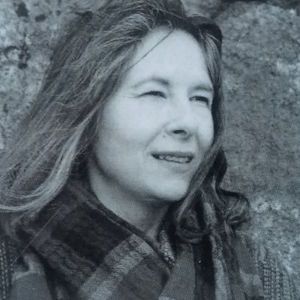
Written by David Lindley
Occupations: Sculptor and Painter
Early Life
Lorna Graves was the daughter of Kathleen Graves née Hardisty, peripatetic farm worker, and John Postlethwaite Airey Percival Graves (1912-1999), son of a South Cumbria clergyman. Her father is described as being ‘of independent means’, the only status given him on the marriage certificate. Not for the first time he gave full expression to his independence, in this instance by leaving the family as soon as Lorna was born. Delivered in Kendal Maternity Home, she was taken to the Mount Hotel where her mother had found both a room for them to live in and the work necessary to keeping body and soul together. Subsequently Kathleen took work on various farms around Carlisle and the Eden Valley, she and her tiny daughter always ‘living in’. Once Kathleen had decided she must find better employment and enrolled as a trainee nurse, Lorna had to be fostered. The household she was allotted to being found harsh and uncaring, she was moved to the Dr. Barnardo’s Home in Scotby. Later in life she wrote of it:
Scotby Orphanage, country and garden and company.~
Authority, kindness, security, peers.
In due course Kathleen qualified as a nurse and remarried, settling in Brampton with her second husband, Richard Graham, and the seven-year-old Lorna who in 1958 became a pupil at the White House Grammar School. She always looked back on her time there with great fondness, loyalty and gratitude. Her life was further enriched when, in 1960, the family moved back to Crosby-on-Eden, next door to Bath House Farm. Now she had access again to the sane, sensible rough-and-tumble of Cumbrian farm life she had known earlier, alongside family, school and friends, with frequent recourse to one of her sacred places, the old Tullie House library. Already her most sacred place was probably Long Meg and her Daughters, the incomparable neolithic stone circle at Little Salkeld in the heart of the Eden valley.
Despite success in her three A levels (English, Art, Geography) Lorna left full-time education, becoming nanny to a family at the MOD barracks, Longtown. Subsequently she took Civil Service exams, and married her childhood sweetheart who by then was lab technician at White House School. But the relationship soon ended in acrimony, and she resumed the direction which perhaps had always been foreseen for her, entering in 1968 on an Earth Sciences degree course at Bedford College, University of London.
Classical Inspiration
For someone who from infancy had an acute sense of the earth and its infinite variety of landforms, this move was natural enough. But a component on Classical Antiquity and the Mediterranean afforded her most enriching experience: on a field trip to Crete she encountered tombs, votive objects and other survivals which she began to relate to the ancient stones and relics of her native landscape in Cumbria. In her second year at Bedford College she formed a close relationship with a fellow-student, a Persian prince usually known by the nickname Mickey Kadjar (born 1949), later a professor of geology at Dallas, Texas. They were briefly engaged, though the more Lorna saw of the privileged life of exile his family led in Paris, the more she knew she could never belong with him.
After graduation she eventually found a job as a librarian at the Museum of the History of Science in Oxford. Among the friends she made in the city was Martin Morris, a little younger than herself. Newly graduated in biochemistry, he had been offered a PhD place at Cambridge. The affinity between them developed quickly; they moved together and on 6th December 1975 were married in the chapel of Churchill College using the rite of the Church of Scotland. Lorna’s father still being entirely absent from her life, she was given away by a Cornish friend of Martin’s.
The newly-weds lived in a thatched cottage out at Girton, and early in the brief but crucial Cambridge interlude Lorna at last moved towards what had long been haunting her. ‘I was a dreamer and I had always painted. I thought of myself as an artist or poet but had never had the courage to follow that path.’ Now she began, enrolling as a part-time student at Cambridge School of Art, visiting the collections in the Fitzwilliam Museum, and travelling to Bath in order to study calligraphy – in its widest sense – with the artist and calligrapher Ann Hechle. ‘Art begins with making a mark’ became one of her central tenets. Meanwhile Martin had enrolled on a course in stringed instrument making, repair and restoration. Himself a cellist, rapid progress in mastering the essential skills persuaded him that his future was as a luthier, not a biochemist. It was a craft which he could practice anywhere. Offered accommodation in a Grasmere cottage (its owner – the son of a Cambridge friend – was serving in Canada as chaplain to the Cree first nation) they were now free to move, in Lorna’s case back, to Cumbria.
The cottage was primitive, and bitterly cold in winter. Prior to the move Lorna had at last tracked down her father, now living with another woman in a caravan in south Cumbria. The fruitless encounter had triggered serious depression leading to a period in hospital. Nevertheless the return to her native county was reassuring and healing, especially when in 1978 she and Martin were able to rent a cottage at Hunsonby in the Eden valley, barely a mile from Long Meg and her Daughters. Amongst the new friends she made was Judith Clarke, then curator of Tullie House, with whom she felt a ready kinship, and who proved to be a lifelong supporter and confidante.
Now, at 34, Lorna was able to enrol at Carlisle Art College as one of the first intake of students on a full-time fine art course for adults. In the next two years, with the help of Geoff Barnfather and Roy May, she essentially found herself, the realities to which she must give expression, and the means to realising what she felt and saw. It was now that she began to make images of a dream which had haunted her since Oxford days. ‘I dreamed of a primitive looking animal and it was in a city square outside a cathedral. People were gathered around it and I was afraid they were going to hurt it because it was vulnerable and absolutely still and as high as the building. The dream stayed with me and when I began my art degree I began to draw this animal.’ Tentatively she interpreted it in Jungian terms, and instinctively took it as a kind of guide. Originally pictured in gouache and pastel beneath a dark blue sky with nine stars blazing around it, this archetypal creature eventually went through scores of incarnations, acquiring by the way a stylised female rider, a perched bird, and at last was crowned with moon and sun.
Of the several media Lorna used (including photography for the temporary shrines, portals, and miniature stone circles she assembled in the landscape), her great discovery was raku ceramic. This Japanese technique involves the removal of items from the kiln when still red hot and the placing of them in a fireproof container filled with straw, dry leaves, shavings, or other combustible material. It makes possible the invention of an infinite depth of rich glazes, every one unique. No one who saw Lorna managing the climax of this process could forget the sense of risk and drama which it generated. Her biggest sculptures she cast in bronze, essential when adding the forms of sun and moon. But she resisted further inflation of the scale of her work, even when pressed to do so by one of her buyers who was blessed with greater than average houseroom, the Marquis of Bute. In fact many of her creations were small items, easily held in the palm of the hand – faces, sleeping female forms, birds, fish, shrines and portals. It was important to her that ordinary buyers of limited means could have examples of her work.
Early Exhibitions
From the Land, her first solo exhibition, was at Grizedale Theatre in the Forest in May 1985. Her second, Spirit of the Land, was held the following year under the aegis of Mary Burkett during her last year as director at Abbot Hall Gallery, Kendal. The next year she had her first exhibition at Tullie House, Carlisle, and then in 1989 her first show in Scotland, The Haunted Sleep, at the Collins Gallery, Glasgow. This was the first of many north of the border, and she was particularly struck by a sentence in The Scotsman’s review: ‘Graves has gravitas’. In fact she was as much amused as gratified. And though many, including Mary Burkett and the poet Kathleen Raine, were deeply impressed by Lorna’s seriousness of purpose, she was anything but solemn in person. From Iona she once wrote, ‘If I had been brought up here I may not have been an artist – there is no search to be made as myth and spirituality are apparent and interwoven. No need to search for the Holy Grail - ‘They’ve already got one!’ (Monty Python)’.
From 1990 onwards a stand at the annual Chelsea Craft Fair enabled her to establish some kind of regular income stream. In the same year she took over 200 pieces to a British group exhibition in California. This event was not a success for most of the exhibitors, and she was greatly disturbed by the sense of native peoples and cultures so very recently destroyed. But she established contact with a gallery in Santa Fe, while her stature in Britain and also in Europe continued to grow. Prince Moritz von Tecklenburg (1923-2014), having seen her work in London, invited her to exhibit at his gallery in the Rhineland, and unsold pieces joined the permanent collection at the Husemann Museum in Munster.
Her personal life underwent many changes. By the mid-1980s she and Martin were growing inexorably apart, he moving back to Cornwall and eventually becoming a successful maker of cellos at Liskeard. Lorna moved to the small town of Brampton, where her rented studio was in the old premises of her alma mater, White House School, the school itself having moved to a new site. But in the winter of 1991 she fell seriously ill. It was the first of three encounters with cancer, this time necessitating a hysterectomy. Her convalescence at The Watermill, Little Salkeld, home of one of her first supporters and patrons, Nick Jones and his wife, helped her to a complete recovery.
Through membership of the Brampton chamber choir she met a musician, Peter Bollada, at that time known chiefly as a guitarist, though his eventual fulfilment would be as a theoretical physicist. A deepening friendship grew between them, and when in 1993 she moved back to Hunsonby (her Brampton bungalow having become subject to compulsory purchase) he joined her at her new home, Apple Tree House. The rest of the decade was a very fulfilling and productive time for them both.
Lorna’s mother had moved down to Yorkshire but they remained very close throughout. And now she was contacted by the nursing home where, to her surprise, her father had been living. Unhappy and very disruptive, he was threatened with ECT treatment for which permission was needed from his next of kin. Lorna refused this, and managed to settle him into a home in Brampton. Eventually she found a place for him in yet another nursing home, down by the Eden in Appleby. Here he was really happy and remained there until his death in 1999. Grateful as he was for his abandoned daughter’s care, the relationship between them at last ‘took’. But it was not until his funeral that she discovered she had a younger half-brother and older half-sister.
Move to London
By then Lorna was effectively living alone again. Her relationship with Peter had by no means run its course, and they remained close friends. Indeed he was one of those with her when she died. But he pursued his career at Lancaster University, Lorna working on at the house and studio in Hunsonby until 2000 when, to most people’s astonishment, she sold up and moved to London. She was able to buy a tiny flat in Thomas Moore House at the Barbican, EC2. Here she found privacy and peace, referring to it as ‘a practical paradise’. The greatest rewards were the many neighbourly contacts and cultural experiences life here made possible. A rented studio in Limehouse enabled her to continue working. She was also able to travel when she wanted, visiting Peter in April 2001 before going on retreat to the Manjurisha Kadampa Buddhist monastery near Ulverston as she had many times before.
But then in June the new life was put on hold when it was found she needed surgery for the removal of a tumour. A second operation, a mastectomy, followed in August. Both operations were carried out at Bart’s hospital, a five minute walk from the Barbican. She convalesced at a home on the south coast before returning to her bed-sit flat at the Barbican, whose outlook onto a garden marked out in chestnut trees was particularly beautiful in autumn. But by the end of the year she was feeling the pull of the north, and once she had been given the all-clear by the medical team she began her search for her next Cumbrian home. She found 3 Oval Terrace, Brampton, in February 2002, at last moving there in September. It was to be her final address.
Again in Cumbria
Not only her invention and creative imagination, but also her physical strength (needed both in creating her work and the mounting and transportation of it) returned in force. After the Burning, a small exhibition at the Bluebell Gallery and Bookshop, Penrith, confronted the horrors of the 2001 foot and mouth epidemic. Of it a friend wrote: ‘After last year’s burning pyres a new profundity is revealed for me in the animal form she created so long before the event, and this work defies the darkness that befell the land.’ A great privilege for her was to become sole keyholder of the LYC gallery at Banks up on Hadrian’s Wall, with its memories of Winifred Nicholson and Li Yuan-Chia. She was visited by many old friends, made new ones, and resumed singing in the chamber choir. At the same time there was ever greater self-reflection and clarification, with a continual questioning of what her art was for; though she perhaps never came closer to self-characterisation than when she had earlier identified with the archetypal figure of the Fool, in one of her short poems:
Fool’s Doggerel
I am the stranger
The dog in a manger
The scapegoat
The Jonah
Non grata persona
The Hag in the storm
My children unborn
I sit by your fires
I hear your desires
I weep for your loss
And carry your Cross
Fulfilling my part
I practice this Art
I work as the Seer
So you can be Freer
At the beginning of 2006 three exhibitions were in prospect, including one at the Beverley Knowles Gallery in London. Lorna’s closest friends, however, knew that she was far from well. At the end of May she collapsed and was taken to the Cumberland Infirmary where she underwent an emergency operation. It was cancer again, this time of the kidneys. Refusing any treatment which had involved the use of animals, she entered the Eden Valley Hospice in Carlisle, and right up to her death on 23rd July was in the immediate company of close friends, and in touch with many who lived far away. A small private funeral was followed by a memorial event in Appleby. Many spoke, read, played and sang, Mary Burkett led the tributes and in conclusion said:
Like a bright star she is one of those memorable worthwhile blessings of our lives in Cumbria. Like other great people she achieved more in her quiet and shortened life than many who live for far longer. We are the fortunate ones; we knew her.
A superb (essentially photographic) account of her work appeared in 2008. Six years later a standing stone - two of its faces finely carved in relief with images from her art, the work of Piers Merry – was planted in a clearing at the edge of a wood near Brampton.
Sources
- Judith Clarke, Jan-Alice Merry and Jeremy Latimer (eds), Lorna Graves (Unipress Cumbria, 2008), with an essay by Judith Palmer and photographs by Val Corbett
- Clare Crossman, Winter Flowers: The Life and Work of Lorna Graves: A Memoir (Bookcase, 2018)
- Author’s correspondence with Lorna Graves