Norman Birkett (1883-1962)
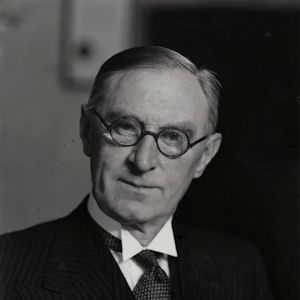
Written by Gabrielle Cliff Hodges
Occupations: Barrister, Judge and Politician
Early years
Norman Birkett was born in 1883 and brought up in Ulverston. It was a friendly place which, in its beautiful setting, he thought of most fondly throughout his life. His father, Thomas Birkett (1854-1913), owned and ran a successful draper’s shop in Ulverston and became a leading figure in the town. Norman cared for him deeply. His mother, Agnes Tyson (1854-1887), was the daughter of Moses Tyson (1803-1875), a builder, and his wife Agnes (née King).
Thomas and Agnes, were Wesleyan Methodists to whom Norman felt he owed a very great deal, especially in religious matters, including the language of the Authorised Version of the Bible and some of the Wesleyan Methodist hymns he loved throughout his life. They had five children, all of whom were born at No. 4 Ainsworth Street, their home in Ulverston. The eldest was Edith (1878), then John Tyson (1880, who died in 1886), Gilbert (1881), Norman (September 1883) and, finally, Ellen (1886). Sadly, Agnes died of tuberculosis in April 1887 when Norman was still only three years old so he had no memory of her. In 1888, however, Thomas married again to a woman also called Agnes (née Dodding) (1852-1901), the daughter of Bartholomew Dodding, a farmer, who was a kind stepmother to the Birkett children as well as having a daughter of her own, Mary, in 1890.
As a young boy, Norman revelled in his childhood, particularly enjoying his schooling, firstly at the Wesleyan Day School in Ulverston and then at the Barrow-in-Furness Higher Grade School, to which he travelled daily by train. The journey provided opportunities for him to exercise his sense of humour and enjoy magic tricks, as his grandchildren fondly remember him doing very many years later. For example, he would pretend to have fallen out of an open carriage window when, in fact, he had climbed into the luggage rack above his fellow traveller’s head as the train went through a tunnel, reappearing as if by magic after it had gone through the next one. He was successful at school but left in 1898 at the age of fifteen, becoming an apprentice in his father’s drapery business, as did his cousin, Henry Birkett (1884), with whom he remained a lifelong friend. Norman worked there for several years, in due course also becoming a local Methodist preacher, a role he enjoyed and in which he proved very popular. To his father’s great satisfaction, he intended to enter the Wesleyan Methodist Ministry but then began to have doubts about his suitability. However, when the Methodist Minister who was coaching him (in 1907) suggested that he might subsequently go to Cambridge University to read
History and Theology (reassuring Thomas Birkett that such a move would be no impediment to his son becoming a minister), Norman welcomed the idea, despite the fact that aged twenty-four he would be quite a bit older than most university entrants.
Cambridge and Birmingham
Travelling by train to Cambridge to sit the university entrance examinations he felt deeply homesick, an affliction from which he continued to suffer for the rest of his life whenever he went away from home. However, he won a place at Emmanuel College and, for the most part, enjoyed his time as a student, working hard at his studies and gradually recognising his excellent debating skills. He became President of the Cambridge Union in 1910. After considerable heart-searching (and mindful of how disappointed his father would be), he abandoned ideas of joining the Ministry and decided to work towards a degree in Law. His father eventually became reconciled to the idea and offered unstinting support. Norman, though, realised how much this course of action was costing his father financially and sought a way to earn his living while waiting to be called to the Bar. Luckily, George Cadbury Junior (1878-1954) (the second son of the Quaker cocoa and chocolate manufacturer at Bournville) was looking for a private secretary and Norman was put in touch with him. It was a good move for many reasons. He was now in receipt of a small salary from which he could save and send money back to his father; and Bournville was where he was to meet his future wife, Ruth Nilsson (1897-1969), born in Glasgow, the daughter of Anne (née Lindgren) and Emil Nilsson, originally from Vanstad, Malmohus, Sweden.
meet his future wife, Ruth Nilsson (1897-1969), born in Glasgow, the daughter of Anna (née Lindgren) and Emil Nilsson, originally from Vanstad, Malmöhus, Sweden. Ruth was always known as ‘Billy’ and was working at Bournville as a physical education instructress. Members of the Cadbury family not only became Norman and Billy’s lifelong friends but also offered openings into aspects of social work which fuelled Norman’s compassionate interest in people from all walks of life.
Call to the Bar and Liberal politics
Norman’s call to the Bar eventually came at the age of 30 in 1913, so he left Bournville and began his pupillage as a barrister in Birmingham. There he also pursued his interest in Liberal politics, standing (unsuccessfully) as Liberal candidate for North Birmingham and fighting, as he later would at the Bar and more widely, for those who were unable to fight for themselves, as well as trying to lessen the divide between wealth and poverty.
At the outbreak of World War I, Norman applied to join the Army but was rejected on medical grounds (though it is unclear what precisely they were). Instead, however, he worked towards the relief of Belgian refugees, serving on a committee led by George’s stepmotherElizabeth Cadbury (1858-1951) which housed and cared for up to 5000 refugees in Birmingham.
Subsequently, despite success in becoming a Member of Parliament for East Nottingham, it was his work as a barrister which he particularly enjoyed and at which he was to prove outstandingly good. Although famous for a wide range of trials, as discussed in great detail in H. Montgomery Hyde’s biography, he was quick to point out (when interviewed by John Freeman for the hugely popular BBC television series, Face to Face 1959-1962), that criminal trials formed only a very small part of his work. Whatever the trial, however, what he loved best was to represent someone to the very best of his ability and, as he put it, ‘to do for the man [sic] what he himself would do had he the ability to do it’. He added that what the defending advocate may think privately is irrelevant; his job is to do everything in his power to persuade a jury to his point of view and secure an acquittal. However, in the same interview with Freeman, he was adamant that he had never defended someone he knew to be guilty because you were not permitted to do so. The amount of preparatory work involved in being a good advocate meant that it was sometimes impossible not to end up thinking the person you were defending might be guilty but judging him was not the advocate’s job; it was the judge’s. When he himself eventually became a judge, he felt the work (though immensely important) paled in comparison with what he had so enjoyed about being an advocate, namely ‘the exercise of persuasive speech’. Nonetheless, despite his feelings, he was at pains to stress that while you have to be impartial as a judge you should never be inhuman.
He acknowledged that his career meant he was not only extremely busy but also very well paid. However, his upbringing led him always to be thrifty and also, as a matter of principle and a form of duty, he took on between six and ten poor people’s cases every year. The profession had been very good to him and he wanted to make some kind of return.
Religious beliefs
Towards the end of the Face to Face interview, Freeman asked about religion and whether Norman would call himself a Christian. Norman’s reply to the question was an unequivocal ‘yes’ in terms of the way he tried to conduct his life, but he added that he found some of the great doctrinal issues of religion ‘perplexing and troubling’ and might therefore better describe himself as a ‘Christian agnostic’.
The move to London
Eventually, in pursuit of his career in the legal profession, Norman moved to London in the summer of 1920. Although Billy was happy in her work at Bournville, she wanted to go with him. Their wedding (on 25 August 1920) was the simplest of ceremonies at St. Pancras Registry Office without friends or relatives, a complete contrast to their subsequent unstinting hospitality, generosity and warmth of welcome at their family homes, notably Challens Green, near Chalfont St Giles in Buckinghamshire where they moved in 1927. They had two children, Linnéa in 1923 and Michael in 1929. (Linnéa and her husband – see below – gave Norman and Billy four grandchildren in the 1950s: three daughters and a son. Michael’s son, their fifth grandchild, was not born until 1982: though proud of his inheritance, he arrived long after Norman and Billy had died.)
One of Billy’s passions was photography, including early ciné film, and the family is lucky to have some old film and a wealth of beautiful enlarged black and white photographs which she relished taking and developing at home. The familycan therefore watch flickering images of Norman with Linnéa (as a tiny child) playing with the family dogs in their garden at home, or friends being persuaded to push the lawnmower up and down while Billy worked the ciné camera – as well as, presumably, getting the lawn mown. Billy’s wonderful eye for photography has left a rich archive of images of Norman. These include photographs taken on holiday in the Lake District, to which they often returned both to visit Birkett relatives and friends and to enjoy a well-earned break.
Norman was always busy, so running the household largely fell to Billy. Although she was a very good cook (especially Swedish pastries), and an extremely keen gardener, she was not domestically inclined, so the Birketts were lucky to be able to employ people to help with the house and look after the children. To their grandchildren, Norman and Billy were delightful grandparents. Norman entertained them with magic tricks, wrote postcards from on holiday with limericks he had made up for them and, to their delight, generally fooled around, for example juggling bread rolls (badly) when they were waiting for a meal and dropping most of them on the floor. ‘Norman, do behave!’ Billy would say.
Of course, as is often the case, there were times when Norman could be difficult to work with. Moreover, as well as suffering from homesickness, he was also prone to depression. Nonetheless, during World War II, though too old to be called up, Norman worked extremely hard and, in 1941, became a judge. During the war years, too, he and Billy (as the Challens Green visitors’ book attests) offered numerous overseas armed forces personnel from countries such as Poland and Canada somewhere to stay when going home on leave was, in those days, out of the question. Comments in the visitors’ book show how much these men appreciated the extraordinary kindness and hospitality extended to them.
The Nuremberg Trials
Immediately after the war, however, came the invitation to be a judge at the Nuremberg Trials. Norman was initially asked to be the main British judge but the Foreign Office wanted a Law Lord so he was asked to be alternate judge instead. Though somewhat disappointed, Norman agreed and thus began his historic year in post-war Nuremberg between 1945-6. The Nuremberg Trials have been well documented, both in print and in film. They involved Norman, yet again, in exceptionally intensive work as well as a year away from his beloved home, apart from returning for Christmas.
It is difficult to imagine what it must have been like in war-ravaged Nuremberg, facing notorious war criminals daily in court, and drafting in large part the final report on the Trials. Billy was with him, however, and his household was run by Gavin Cliff Hodges (a former soldier and fluent German-speaker) who became Norman’s marshal for the year. Gavin’s accomplishments are set out in a long letter to him from Norman afterwards, thanking him warmly for his many responsibilities and his exceptional modesty in fulfilling them. As well as supporting Norman’s work and running the household, Gavin also took Billy out to explore the German countryside. She always had her camera with her so there are manifold photos. Importantly, too, Gavin met Linnéa Birkett when she came out to Nuremberg in the spring of 1946 and they married in London in 1949.
Lord Justice of Appeal
In 1950, Norman was invited to be a Lord Justice of Appeal, a role which he appreciated but did not enjoy as much as being a barrister. However, he undertook his responsibilities with customary care and commitment. Not being away so much allowed him time for other interests such as reading, watching cricket and playing golf. He was much in demand as an after-dinner speaker, too, and a keen supporter of education and literature, much to the gratification of his granddaughter Gabrielle, an English teacher. In 1951, he was President of The National Book League giving its annual lecture on the theme of The Use and Abuse of Reading. He was also President of the English Association in 1953, addressing them with a talk entitled The Magic of Words. As a great admirer of Charles Dickens, he made what was to be his last radio broadcast in 1962: a discussion with Margaret Lane about Dickens on the eve of what would have been the author’s 150th birthday. During these final years, Norman gave many other talks, including at various school speech days. It was a hectic schedule.
The countryside
As it turned out, though, the final great contribution he was to make was to the Lake District. In 1945, he had given the Rede Lecture at Cambridge entitled National Parks and the Countryside. He was all too well aware, even then, of the inequalities caused variously by issues of land ownership, compensation and the right to roam. Now, too, as ever, Norman felt moved to fight strenuously against exclusive encroachment on land that should be ‘for all people in all times’.
In February 1962, just two days before he died, Norman Birkett made a speech in the House of Lords, arguing vehemently against the Manchester Corporation’s Bill which proposed siphoning off water from Ullswater without having undertaken the requisite consultation with the authorities and with all the ill effects that would have ensued for the lake and its surroundings. However, as a Lancastrian, he was at pains to stress his longstanding admiration for Manchester itself and to point out that he did realise the city’s need for more water but not without due consultation. He was therefore relieved by, and jubilant about, his success in preserving Ullswater from the scheme for the time being. Next morning there were numerous tributes, newspaper reports and letters including a heart-warming one from the Fifth Form at a secondary school for girls in Barrow-in-Furness. The girls (whose responses no doubt owed much to an astute teacher) wrote to thank Norman for all that he had done to save Ullswater. ‘It was a great relief to us,’ they said ‘for we have been following the reports and debates steadily in the newspapers and on television. For the first time in our experience, we have been personally interested in the workings of Parliament, and are quite thrilled at the outcome of our first contact with it.’ They went on to tell him about pictures and notices on the question posted all round their school corridors, and about their flourishing Rambling Club. Finally, they informed him that they already knew of him because they had talked about him earlier in the week when he was chief speaker at the Dickens 150th birthday celebrations dinner. They ended their letter with words which must have touched him deeply: ‘We think you are interested in the things that matter, and should like to tell you so.’ The notion that the girls thought he was ‘interested in the things that matter’ could well stand as an epitaph to Norman’s life; the fact they also wanted to tell him so seems a truly fitting tribute for a man to whom communication between people mattered so much. He died later that night when his heart failed under anaesthetic for an operation to try to cure a fatal blood vessel impairment.
Memorials
It was Norman’s wish that he be cremated and that there were to be no funeral or memorial services. However, there were other tributes in which he would, no doubt, have delighted. A 725-metre-high Lakeland fell to the west of Ullswater, hitherto Nameless Fell, was re-named ‘Birkett Fell’ in his honour. A cairn was built at the top with a Westmorland slate plaque set into it which simply read ‘Birkett Fell’. From the top of Birkett Fell, you can look down to Ullswater where another plaque of slate from a local quarry was set into the rock at Kalepot Crag facing out onto the water. Below his name, it read simply: ‘He loved Ullswater. He strove to maintain its beauty for all to enjoy.’ Poignantly, it can only be seen from the lake itself.
Since 1962, further commemorative tributes have followed, for example a talk by longtime Ullswater resident and activist, Miles McInnes, called ‘How the lake was saved: The story of Lord Birkett and the Ullswater Preservation Society’. It includes information about another plaque, this time raised by the Ullswater Preservation Society, with lettering hand cut into beautiful local slate which reads:
ULLSWATER
THE LAKE WAS SAVED
HOUSE OF LORDS, 8 FEBRUARY 1962
REMEMBER
Norman, Lord Birkett PC QC
THE ULLSWATER PRESERVATION SOCIETY
Around the curved lower edge of the plaque are the words SI MONUMENTUM REQUIRIS CIRCUMSPICE, taken from Christopher Wren’s monument in St Paul’s Cathedral, which translate as ‘If you seek his memorial - look around you’.
Every year in summer, too, a prestigious sailing race, known as the Lord Birkett Memorial Trophy, is organised by the Ullswater Yacht Club, attracting over 200 entries. It is a two-day event and takes place in the glorious setting of Ullswater. Norman would have relished the sight.
There are, of course, many others who have in the past contributed to the fame of the Lake District and many more who continue to do so, whatever the challenges it faces. Norman would not, I think, have wanted to be singled out particularly, but he will be remembered, as the Fifth Form girls from Barrow rightly suggest, because he, for one, cared and brought all his manifold skills to bear on things – whatever they were – that mattered not just to him but also to so many other people.
Sources
- Ancestry.com
- MyHeritage.com
- Norman Birkett, National Parks and the Countryside, The Rede Lecture, (1945)
- Norman Birkett, The Use and Abuse of Reading, The Eighth Lecture of the National Book League, (1950)
- Norman Birkett, The Magic of Words, The English Association Presidential Address (1953)
- John Freeman, An interview with Lord Birkett, Face to Face, British Broadcasting Company (BBC), (1959)
- Montgomery Hyde, Norman Birkett: The Life of Lord Birkett of Ulverston, (1964)
- Richenda Scott, Elizabeth Cadbury 1859-1951, (1955)
- The Friends of Ullswater Way https://www.ullswaterheritage.org
- Lord Birkett Memorial Trophy https://www.ullswaterycbirkett.org
- Family information