John Bolton (1756-1837)
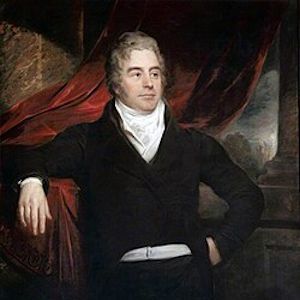
Written by Tim Cockerill
Occupations: Slave Trader, Owner and Volunteer Officer
Early Life
John Bolton was born and baptised at Ulverston in 1756, the youngest son of Abraham Boulton (1720-1764), an apothecary and a native of that place, who had been apprenticed to George Smith of Skipton before practising in Ulverston. His grandfather, another Abraham Boulton, had married Elizabeth Smith probably in about 1715, so George Smith may well have been a relation. In 1739 John Bolton's father had married Ann Philipson (1721-1810) of Dalton-in-Furness at Dalton and they had six children, two boys and four girls. Abraham Boulton died when his son John was eight years old and he was educated at Town Bank Grammar School, Ulverston before being apprenticed in Liverpool. Later he adopted the simpler spelling of Bolton, perhaps to avoid mis-spellings.
Career
Young John was apprenticed to the firm of Rawlinson and Chorley, major importers of cotton from the West Indies, of Hanover Street in Liverpool. In 1773, when he was only 17, the firm sent him to St Lucia and afterwards to St Vincent. Years later, in 1800, George Baille (1757-1809), another West Indian merchant, wrote to Bolton, saying that the first time he ever saw him was in 1773, when he landed in St Vincent dressed in a sailor suit, carrying a bag of potatoes on his back and a cheese under his arm, to be sold for cash. Baille had helpfully purchased the cheese.
John Bolton began his career behind a shop counter but five years later he was promoted by his employers to be an agent, typically retailing their Liverpool cargoes of food and clothing. By 1790 Bolton, then aged 34, returned to Liverpool a rich man and was thus able to break free from Rawlinson and Chorley and start a business on his own account.
In Sir Clement Jones's John Bolton of Storrs, published in 1959, the author says that Bolton's fortune was based on sugar, rum and cotton, all produced on slave run plantations. Jones goes on to quote an unidentified author who asserted that despite extensive research he had found no link between Bolton and slavery. This turns out to be a reference to a 1941 article written by Godfrey W. Mathews FSA and published in the Transactions of the Historic Society of Lancashire and Cheshire. Jones, perhaps conscious of this important lapse in an otherwise accurate article, fails to either name the author or give any other reference to it, though he had drawn upon it heavily. However, Jones immediately points out the error and then produces clear evidence that Bolton was much involved in both slavery and the slave trade over many years. For example, Sir Clement refers to Bolton's two ships called The John and King George which in 1799 alone shipped 952 slaves to Angola. Further, between 1783 and 1807, Bolton invested in 73 slaving voyages, often as the sole investor in the last days before slavery was abolished.
Politics
John Bolton played a prominent part in Liverpool politics from about 1807 until his death thirty years later. A Tory, his house in Duke Street, Liverpool, became the party's local headquarters from 1812 and the future prime minister George Canning (1770-1827) often addressed the crowd below from the balcony.
In 1804 Bolton was elected to the Liverpool Town Council without his knowledge or consent, whereupon he refused to attend any meetings. When the Town Clerk was instructed to compel his attendance Bolton held his ground, quite reasonably explaining to the Mayor that he had never consented to sit and, in any event, his uncertain state of health and frequent absences from Liverpool forced him to decline the honour. No more was heard of the matter.
In 1818 with or without his consent, Bolton was nominated as a parliamentary candidate for Liverpool, in somewhat confusing circumstances, but withdrew before the election.
Storrs Hall
Although based in Liverpool, John Bolton remained devoted to the Lake District and in 1806 bought the Storrs Hall estate on the eastern shore of Windermere. The house had been built in 1761 by Sir John Legard, 6th Bart., (c.1758-1807) of Ganton Hall in the East Riding of Yorkshire, a keen yachtsman. In addition to the house, he enhanced the lakeside by erecting the ‘Temple to the Heroes’, a commemorative building on the end of a stone jetty, celebrating the admirals, Nelson, Howe, St Vincent and Duncan.
Sir John sold the estate in 1804 to David Pike Watts (1754-1816), a wealthy London brewer and vintner, whose sister was the mother of John Constable the painter. It was Watts who encouraged the artist to visit the Lake District. Soon afterwards, in 1807, Watts sold the estate to Bolton, who lost no time in altering and enlarging the house to the designs of the well-known Liverpool architect Joseph Michael Gandy (1771-1843), who had already designed a boathouse there for Legard. Storrs Hall faces south, standing on a promontory jutting into the lake, about two miles south of Bowness, and enjoys fine views in three directions.
Here John Bolton enjoyed sailing and hosted a number of large regattas on the lake, notably one in 1825 attended by his friends, including William Wordsworth, Sir Walter Scott and John Wilson (1785-1854) the author who wrote under the name of 'Christopher North', and the future prime minister George Canning, whom he had known in Liverpool. Both Wiiliam and Dorothy Wordsworth always spoke highly of Bolton and he was apparently noted locally for his good works, acts of kindness and hospitality. He was also a friend of Robert Southey ( 1774-1843) of Greta Hall, Keswick, Poet Laureate from 1813 until his death.
John Bolton and his wife lived at Storrs Hall in some style with a large staff, although it seems that Bolton was often absent at his town house in Duke Street, Liverpool, conducting his business from which he never retired. In 1840, after her husband's death, Mrs Bolton lent her late husband's magnificent cedar wood barge to transport the widowed Queen Adelaide up Windermere to the Le Fleming family seat of Rayrigg Hall and thence to Ambleside, from where the Queen went by carriage to meet their kinsmen the Flemings at Rydal Hall before paying a visit to the Wordsworths at Rydal Mount. Queen Adelaide was staying with several courtiers at the White Lion Hotel in Bowness, which promptly changed its name to ‘The Royal’, the other hotel becoming ‘The Crown’. There is no evidence that Mrs Bolton ever met the queen.
Mrs Bolton remained living at Storrs Hall until her death in 1848, when her nephew, the Revd. Thomas Staniforth (1807-1887), rector of Bolton-by-Bowland, Lancashire, inherited the estate, which in 1873 comprised 811 acres. However, he did not move in until his retirement in 1859, when he was 52. Educated at Eton and Christ Church Oxford, where he rowed stroke to win the first university boat race in 1829, his upbringing , so unlike Bolton's, enabled him easily to assume the lavish life-style of his uncle by marriage. He married twice but, having no immediate family, the Storrs Hall estate was sold off in lots on his death in 1887, when he left a personal estate of £150,442. After that it became successively a girls' school, a boys' school, a youth hostel and is now a four star luxury hotel.
Benefactions
Despite Bolton's obvious connections with both slavery and the slave trade he seems to have had many friends from far and wide. The locals did not shun his company or refuse to work for him (he may have paid his staff well) but as the campaign to abolish first the slave trade and then slavery became more intense there must have been some who wanted nothing to do with him. He retained his plantations and numerous slaves, until slavery was finally abolished in the British Empire in 1833.
Despite killing a man in a duel and not being prosecuted, as public opinion felt his conduct had been justified, John Bolton continued to play his part in local and national affairs. During the Napoleonic Wars he gave £500 (now at least £25,000), to the government towards the defence of the realm in 1797 and in 1803 he raised a battalion of 800 volunteers in Liverpool. Known as the Liverpool Volunteers it was soon christened ‘Bolton's Invincibles’ after its Lieutenant Colonel commanding. For three years, Bolton fed, housed, armed and trained his men at his sole expense and only relinquished this financial burden when the battalion was disbanded in 1806, upon the creation of the local militia (a body defined as ‘a military force conscripted in an emergency’).
In 1829 Bolton gave £500 towards the building of the new church of Holy Trinity in Ulverston, the total cost being £4,700 (now about £300,000), and he laid the first stone. This church has now been converted to apartments.
His last benefaction was in 1836, a year before his death, when he paid for a new school at Bowness to replace the old grammar school founded in 1637. This time it was William Wordsworth who laid the foundation stone. There remains a fine portrait medallion of Bolton attached to a wall at that place, not far from the Spinnery at Bowness.
Personal Life
In 1797 John Bolton was married at St Marylebone Church, London to Elizabeth Littledale (1768-1848), daughter of Henry Littledale (1741-1796), a mercer and draper of Whitehaven. Her brothers included Sir Joseph Littledale PC (d. 1842), a judge of the Court of Queen's Bench and Anthony Littledale (d. 1820) of Liverpool, a future business partner of John Bolton. The Littledale family were prominent merchants in Whitehaven in the 18th Century and in 1786 Elizabeth's uncle Isaac Littledale (1735-1791) was the co-founder of the first private bank in Whitehaven with his brother- in-law Thomas Hartley (portraits of whom were given by the author to Wordsworth's house in Cockermouth, where the National Trust have them on display).
There were no children of the marriage and presumably Bolton had no close relatives of his own as, after his wife's death in 1848, his wife's nephew, the Revd Thomas Staniforth (qv) succeeded to his fortune and to the Storrs Hall estate.
Slavery Compensation
By the mid-1830s Bolton's health gradually declined but not before he was able to submit his compensation claim to the British Government for the emancipation of his slaves. The Centre for the Study of the Legacies of British Slavery at London University have summarised and made public the relevant information recently. This shows that Bolton, either as sole or joint owner, was in possession of ten plantation estates in British Guiana, Demerara, St Vincent and St Croix. Ultimately his estate was awarded a total of £35,240-13-7d (now at least £2,100,100) in respect of his 783 newly emancipated slaves.
The Last Years
When John Bolton died in 1837 at his house in Duke Street, Liverpool his obituary in the Gentleman's Magazine described him as ‘one of Liverpool's most honourable merchants and bountiful benefactors, an ornament to society who was held in the highest esteem by his friends, whom the poor blessed and whose memory would be long cherished by all who appreciated worth and benevolence’. Shortly before his death he had given £2,000 to various Liverpool charities. Apart from a brief mention that Bolton had resided for some time in the West Indies, there was no mention of any connection with slavery or the slave trade.
Sir Clement Jones’s book on John Bolton devotes a five page chapter to his enormous funeral, believed to have been the largest ever seen in Liverpool at that date, bar the funeral of William Huskisson MP, who was killed by Stephenson's Rocket at the opening of the Liverpool to Manchester railway in 1830.
Bolton's cortege included 300 Blue Coat schoolboys, 250 men on foot, 60 on horseback and 30 gentlemen’s private carriages. They travelled a further 32 miles from Kirkdale, on the outskirts of Liverpool, to Preston, a further 21 miles to Lancaster on the next day and on the following day it finally arrived at Storrs Hall, after another 31 miles. There the coffin lay in state overnight before the final procession to Bowness church, accompanied by between 20 to 30 private carriages of the local gentry.
Bolton's body was deposited in a vault to the west end of the church, over which a slab was subsequently placed, giving simply his name and dates (in 1848 his widow was buried with him and the slab also records her details.)
John Bolton left an estate of £180,000 ( now about £10m), but this did not include his real estate of land and houses, as these were not then taxable or subject to death duties. That change began in 1894. It is unclear to what extent his slave compensation was included in the figures.
His Character
John Bolton must have been an exceptional personality, by any reckoning. Starting with nothing he made a huge fortune in the West Indian trade, and was thus able to buy a significant landed estate and set himself up as a rich country gentleman.
An amusing snapshot of his personality by his friend James Aspinall, (probably the James Aspinall (1795-1861) the Liverpool merchant and banker) recorded in 1853 that ‘Bolton was a man who worked his own way up from poverty to riches and then lived in a magnificent way ... no one knew the value of silence better than he did. He had not received much education but he saved appearances by making it an invariable rule never to open his mouth on a subject he did not understand.’
Sir Clement Jones, himself a distinguished businessman and public servant with Cumbrian connections, (his Welsh father was vicar of Burneside and his mother, a Cropper, a descendant of the Wakefields of Kendal) seems in the 1950s to have been at some pains to bring out Bolton's good qualities, such as his undoubted philanthropy both in Liverpool and the Lake District, his gift for friendship and his lavish hospitality, but casts no aspersions about the source of his wealth. Perhaps he was only trying to be fair to his subject at a time when slavery was not so controversial; today a rather different stance would be adopted.
Sources
- Ancestry.com
- Baines, Edward, History, Directory and Gazatteer of the County Palatine of Lancaster 1824, reprint 1968 by David and Charles
- Birkett, Henry F., The Story of Ulverston, Kendal, 1949
- Boumphrey, R.S., Hudleston, C Roy, and Hughes, J. An Armorial of Westmorland and Lonsdale, Kendal, 1975
- Burke, Ashworth P., Burke's Family Records, (for Littledale), London , 1897
- Clergy List, London, 1880
- http://rumbutter.info/gen-cumb-nr-places-whitehaven-19-century-littledale
- Jones, Sir Clement, John Bolton of Storrs 1756-1837, Kendal, 1959
- London University, Centre for the Study of the Legacies of British Slavery
- Mannex, P.J., History, Topography and Directory of Westmorland and Lonsdale North of the Sands, London, 1849
- Parson and White, History, Directory and Gazetteer of the Counties of Cumberland and Westmorland and Furness and Cartmel in North Lancashire, Leeds, 1829
- The Return of Owners of Land in England and Wales 1873, London, 1875
- Wikipedia