Jane Roger (‘Jenny Darney’) (fl. 1770–1790s)
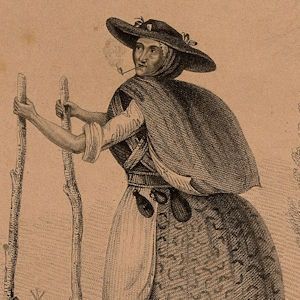
Written by Christopher Donaldson
Occupations: Mendicant, Recluse and Eccentric
A mendicant, recluse, and eccentric figure from western Cumbria, remembered for her unique way of life in the late eighteenth century. Known locally and in contemporary accounts as ‘Jenny Darney’, she attracted attention for her unusual dress, solitary habits, and apparent disregard for material wealth.
Very little is known about Roger’s early life. Neither her birthplace nor her date of birth is recorded, and even during her lifetime these details were a subject of speculation. It is believed she had family connections in Whitehaven, though she is said to have been reluctant to speak of her origins. Parson and White’s History, Directory, and Gazetteer of Cumberland and Westmorland (1829) states that she died in old age at the house of a relation in Whitehaven.
Roger eventually settled near Holmrook, close to the village of Drigg. From approximately 1776 to 1782, she reportedly lived alone in a repurposed cow house on the Holmrook Hall estate, then owned by Charles Lutwidge (1722–1784). Although the circumstances of her settlement on the estate are unclear, the fact that she was allowed to reside there rent-free may suggest some form of personal or charitable connection to the Lutwidge family.
Roger became locally renowned for her self-sufficient lifestyle and idiosyncratic attire. She also attracted wider notoriety as a curiosity or ‘odd woman’. An article in the Gentleman’s Magazine from 1790 describes how she fashioned her own clothing entirely by hand. She is said to collected bits of wool from sheep pastures, spun the wool using a rock and spindle of her own design, and then knitted it into garments using homemade wooden needles. Her clothing was said to be warm and practical, consisting of flannel petticoats, coarse stockings, and a black stuff hat. A portrait published alongside the article depicted her as a sturdy figure equipped with walking sticks, a pipe, a sack, and several small purses.
Despite living in poverty, Roger refused to accept money, although she would accept gifts of food and tobacco. She was often seen smoking a pipe and reportedly travelled with it ‘constantly in her mouth’. Her proud rejection of charity and money earned her a reputation for dignity and independence. Some contemporaries even regarded her with reverence, interpreting her lifestyle as one of religious devotion and voluntary retreat from society. According to the Gentleman’s Magazine, she lived in seclusion in order to prepare herself for ‘a better [world],’ expressing a ‘distaste of a wicked world.’
Accounts from the period suggest that Roger may have struggled with her mental health. The Gentleman’s Magazine noted in 1790 that ‘her intellects seem at certain times greatly deranged.’ She was nevertheless evidently respected and even admired by those who knew her. Locals took an interest in her welfare, and her eccentric yet principled way of life contributed to her local fame.
Little is known about Roger’s life after her time at Holmrook. She was likely still residing near Drigg as late as 1785, when the Revd Robert Throsby of Leicester appears to have encountered her during a visit to the area. In his letters, Throsby described a beggar woman who came to the house where he was staying, receiving a donation of oatmeal and carrying it off in a prepared sack, possibly a reference to Roger.
Her final years are obscure, but Parson and White’s Directory states she eventually died in Whitehaven, ‘disabled by age and infirmities’, in the home of a relative.
Sources
- William Parson and William White, History, Directory & Gazetteer of Cumberland & Westmorland (Leeds, 1829), p. 205
- ‘Odd Women’, All the year round, 14 November 1875, pp. 113–17
- M., ‘Jenny Darney, of Cumberland’, Gentleman’s Magazine, 1791, pp. 1081–2
- Reverend Robert Throsby, letter written at Carleton Hall, Drigg 26 July 1785; courtesy of Alan Bell to whom the author is very grateful.